

The "Good Job" Trap
But then, a few days later, they try to build a tower out of wooden blocks. The tower wobbles and crashes down. They try again; it crashes again. Suddenly, a cold feeling of fear enters their little heart. They look at the fallen blocks and think, Oh no. I can't do it. If I can't build this, it means I am not smart anymore. Mommy won't think I am a genius.

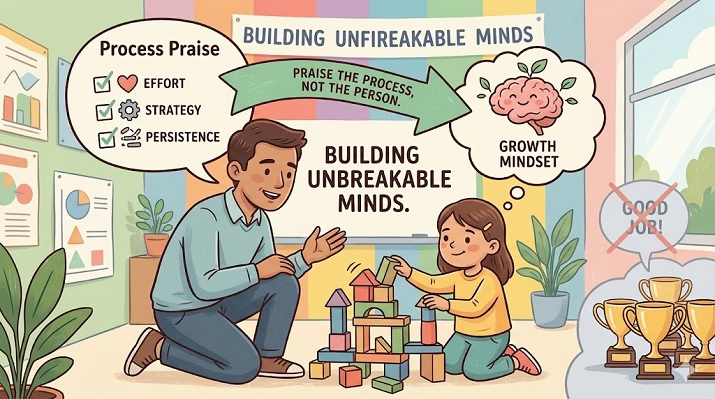
Let us think about a tall, sturdy ladder. When we tell a child, "You are so smart," or "Good job, you are the best painter," we are placing them at the very top of that ladder. They look down, and it feels high and scary. They think to themselves, Wow, Mommy thinks I am perfect. She thinks I am a natural genius.
But then, a few days later, they try to build a tower out of wooden blocks. The tower wobbles and crashes down. They try again; it crashes again. Suddenly, a cold feeling of fear enters their little heart. They look at the fallen blocks and think, Oh no. I can't do it. If I can't build this, it means I am not smart anymore. Mommy won't think I am a genius.
To protect themselves from falling off that high ladder of praise, the child decides to do something sad: they stop trying. They only want to do things they already know how to do perfectly. They choose the easy puzzle they have done ten times instead of the new, harder puzzle. They become risk-averse. They avoid the risk of looking foolish because their identity has been tied to being perfect, not to the effort of learning.
When we praise the result (the perfect grade, the beautiful drawing, the winning goal), we accidentally teach our children that we only value the trophy at the finish line. We do not teach them to love the long, dusty run it takes to get there.
Shifting from the Trophy to the Blueprint
So, what do we do instead? Do we stop praising our children completely and become cold and silent? Absolutely not! The secret is to shift our eyes away from the trophy and look closely at the blueprint—the strategy, the sweat, the focus, and the choice to keep going when things get tough.
Scientists who study the brain call this building a Growth Mindset. A child with a growth mindset believes that their brain is like a muscle. They know that when a math problem is hard, or when they can't balance on their bicycle, that frustration is actually the sound of their brain muscle growing stronger. To them, failure is not a heavy stop sign; it is just a bend in the road that says, "Let us try a different way."
To build this kind of mind, we need to change our praise from a generic judge's score into a descriptive camera. Instead of judging the final product, we simply describe the hard work we saw happening.
Let us look at three common situations where we can trade the "Good Job" trap for life-giving, resilient words.
Situation 1: The Art Creation
Your child brings you a painting. It is a bit messy, but they spent forty minutes working on it without looking at a screen.
-
The Old Trap Way: "Wow, good job! You are the most talented artist in the whole world!" (The child learns: I must always make beautiful art to be loved.)
-
The New Growth Way: "Look at all those bright red lines! I saw you sitting at the table for a very long time, working on that corner. You didn't give up even when the paint spilled a little bit. How did you choose these colors?"
Why this works: You are acting like a mirror. You are showing them that you noticed their focus and their patience. You are asking them about their choices, which makes them feel like a real thinker, not just someone waiting for a gold star.
What's Your Reaction?
 Like
0
Like
0
 Dislike
0
Dislike
0
 Love
0
Love
0
 Funny
0
Funny
0
 Wow
0
Wow
0
 Sad
0
Sad
0
 Angry
0
Angry
0
Comments (0)